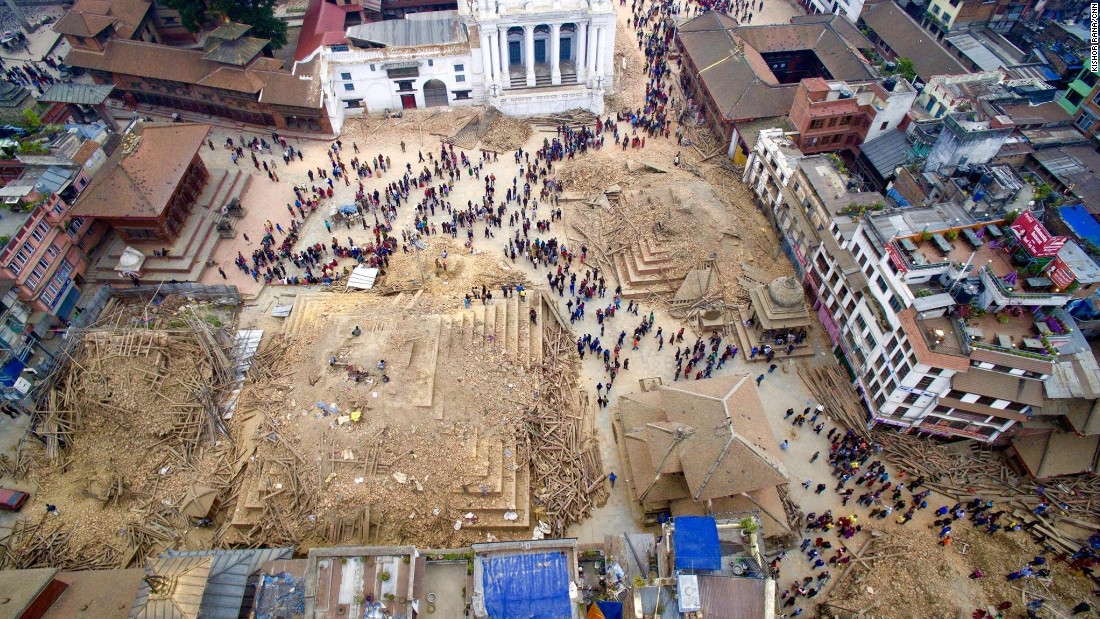
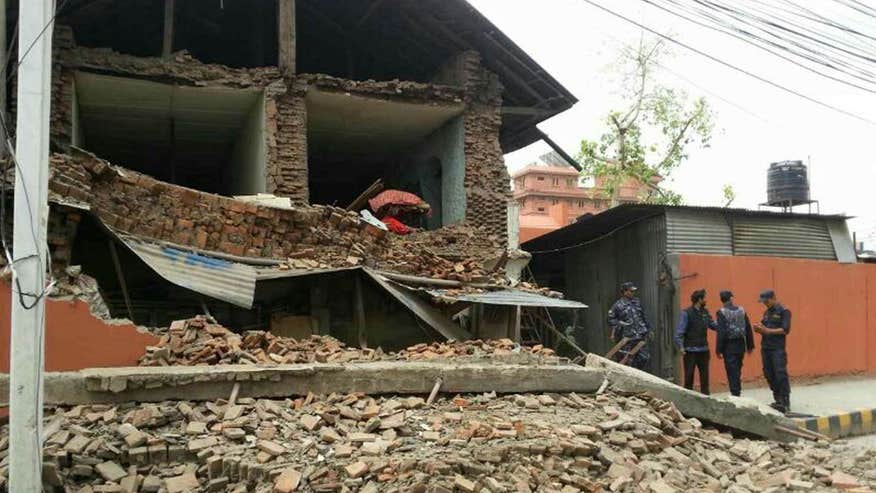
Drones are proving a crucial high-tech tool for aid workers in the aftermath of the devastating Nepal earthquake.
With the death toll from Saturday’s 7.8-magnitude quake now over 5,000, rescuers and relief workers are scrambling to get aid to the country’s worst-hit areas.
Experts from Etobicoke, Ontario-based GlobalMedic, which manages a fleet of Unmanned Aerial Vehicles (UAVs) for international disaster relief missions, is already in the Himalayan nation. “Our UAV team is tasked with aerially mapping crisis-affected areas, then compiling and cross-stitching the collected imagery into maps that provide a superior snapshot of needs on the ground,” wrote a GlobalMedic spokeswoman, in an email “Identifying flooded areas, obstructed roads, population movements, and damaged infrastructure, the possibilities for UAV use in an emergency setting are extensive.”
The aid organization is using three high-end UAVs in Nepal. The SkyRanger and Scout drones, built by Aeryon Labs, are controlled via a touchscreen interface. Equipped with thermal cameras, the devices can identify people who are trapped or injured.
Haunting drone footage from Nepal reveals a patchwork of collapsed buildings and wrecked temples, underlining the scale of the destruction. The U.N. says the disaster has affected 8.1 million people — more than a fourth of Nepal's population of 27.8 million — and that 1.4 million needed food assistance.
Officials and foreign aid workers who have rushed to Nepal following the earthquake are struggling against stormy weather, poor roads and a shortage of manpower and funds to get assistance to the needy.
GlobalMedic said that its drones record and transmit information in real time, helping to assign priority areas for humanitarian aid and identifying accessibility issues. “These maps are vital in the assessment of humanitarian needs,” said the spokeswoman. “All mapping information and results will be shared with the U.N., the Nepalese government and all coordinating agencies responding in Nepal. The aim is to disseminate this invaluable information so the humanitarian network can coordinate effectively, eliminate gaps and overlaps in programming, and save more lives.”
The Canadian organization also used its UAVs during the relief efforts after Typhoon Hagupit struck the Philippines last year.
GlobalMedic Director Rahul Singh said that information is key in any emergency scenario. “In an emergency if you call 911 – help is sent. But the right help is sent based on the information gleaned from the caller,” he wrote, in an email. “Nepal has called for a Global 911 response - the images from these UAVs will be that information. This is crucial to ensuring aid is delivered more effectively.
Messenger, NASA’s Mercury-orbiting spacecraft, reached the end of its historic 11-year mission Thursday when it crashed into the little planet closest to the sun.
The spacecraft, which was out of fuel, slipped out of orbit and slammed into Mercury at 3:26 p.m. ET, according to mission controllers at the Johns Hopkins University Applied Physics Laboratory (APL) in Laurel, Md.
Mission control confirmed end of operations at 3:40 p.m. ET,when no signal was detected by NASA’s Deep Space Network (DSN) station in Goldstone, Calif., at the time the spacecraft would have emerged from behind the planet
At 3:16 p.m. ET, the mission's @MESSENGER2011 Twitter account had tweeted: "Well I guess it is time to say goodbye to all my friends, family, support team. I will be making my final impact very soon."
At 3:23 p.m. ET @MESSENGER2011 tweeted "#thatsmessenger" and an image of Mercury's surface, with the message "Messenger's last act? That's smashing!"
Messenger made history in March 2011 when it became the first probe to orbit Mercury.
The crash ended a successful mission for Messenger, which was launched in August 2004. The spacecraft has undertaken extensive mapping of Mercury during its journey, and has sent a slew of data on the planet back to earth. Messenger, for example, found vast troves of sulfur on the planet’s surface. Messenger’s original goal was to take 2,500 images of the planet, but it has returned more than 270,000 to earth.
More looting was reported Tuesday morning in Baltimore, after a night of chaos and rioting that prompted the National Guard to swarm in to restore order.
The looting appeared to be isolated compared to Monday night, which damaged parts of the city. State officials worked to cut off any new rioting by employing National Guard troops along with city police officers. These police officers were stationed at various key points throughout the city.
The increased police presence came after Gov. Larry Hogan, a Republican and Baltimore Mayor Stephanie Rawlings-Blake were criticized for what was perceived by some as a slow response. Hogan, at a morning press conference, vowed to keep the protest agitators at bay by talking with community leaders and deploying more police.
Looted storefronts were being boarded up, burned cars hauled away and as many as 20 police officers were recovering from injuries suffered during the rioting that broke out when high school kids used social media to launch a coordinated "Purge," the slang term taken from a movie and meaning a night where laws are not observedAmid the rioting Monday night that led to 200 arrests, Mayor Stephanie Rawlings-Blake strongly condemned the "thugs" behind the mayhem and announced a 10 p.m. to 5 a.m. curfew beginning Tuesday and lasting at least a week.
Too many people have spent generations building up this city for it to be destroyed by thugs who, in a very senseless way, are trying to tear down what so many have fought for," the mayor said. "It's idiotic to think that by destroying your city, you're going to make life better for anybody."
Despite reports of a gang pact to attack police officers, those injured appeared to have been hurt by rock-throwing youngsters in an early confrontation. For most of the evening, police battled flare-ups around the city before National Guard troops arrived in Baltimore shortly after midnight and helped quell the rioting.
The Rev. Jesse Jackson has visited a burned-out drug store in Baltimore as crowds gather in the streets a night after riots.
Jackson said the violence, while inexcusable, reflected the alienation of unemployed people in neighborhoods full of empty homes and vacant lots.
It was painful because it destroyed a lot of neighborhood businesses and hurt a lot of people, but the violence is driven by that alienation," Jackson said.
City Police Commissioner Anthony Batts admitted that his officers were not prepared for the outbreak of violence that forced Maryland Gov. Larry Hogan to declare a state of emergency.
Yes, we planned for it. That wasn't the issue," Batts told reporters late Monday. "We just had too many people out there [for us] to overcome the numbers we had. The commissioner added that the rioters had pulled his officers to opposite ends of the city and had outnumbered us and outflanked us.
These acts of violence and destruction of property cannot and will not be tolerated," Hogan said at a late-night press conference. The governor also said he was deploying 500 state troopers and had asked for 5,000 officers from neighboring states to deal with the violence.
Batts said the National Guard would be used to take control of what he called "structures and fixed posts" to support police efforts to regain control of the city's streets.
As the violence grew Monday, officers wearing helmets and wielding shields occasionally used pepper spray to keep the rioters back. For the most part, though, they relied on line formations to keep rioters at bay. After midnight Monday, authorities were still struggling to quell pockets of unrest.
The violence began hours after Monday's funeral for Freddie Gray, a 25-year-old man who died last week from a severe spinal cord injury he suffered while in police custody. Gray's fatal encounter with officers came amid the national debate over police use of force, especially when black suspects, like Gray, are involved. Gray was African-American. Police have declined to specify the races of the six officers involved in his arrest, all of whom have been suspended with pay while they are under investigation.
Gray's family denounced the violence late Monday, saying it was not the way to honor him
I think the violence is wrong," Gray's twin sister, Fredericka Gray, said. "I don't like it at all.
The attorney for Gray's family, Billy Murphy, said the family had hoped to organize a peace march later in the week.
Looters were seen smashing their way into stores during the riots.
During Gray's funeral Monday, police released a statement saying that the department had received a "credible threat" that three notoriously violent gangs are now working together to "take out" law enforcement officers. A police source told Fox News several gangs, including Black Gorilla Family, Bloods and Crips all had “entered into a partnership to take out law enforcement officers.”
The confrontation that sparked the violence stemmed from an online call for a "purge" that would begin at the Mondawmin Mall in west Baltimore and end downtown. The phrase is a reference to the 2013 movie "The Purge", which takes place in a world in which crime is made legal for one night only.
Alerted to the warning, authorities mobilized police officers to the Mondawmin Mall in west Baltimore, within a mile of where Gray was filmed being arrested and pushed into a police van April 12. The shopping center is a transportation hub for students at nearby schools.
At 3 p.m., the time of the reported "purge," between 75 to 100 students on their way to the mall were greeted by police in riot gear. The students began throwing water bottles and rocks at the officers, who responded with tear gas and Mace. As the crowds at Mondawmin Mall began to thin, the riot shifted about a mile away to the heart of an older shopping district near where Gray first encountered police.
One worker inside the mall told FoxNews.com that stores in the shopping center were badly damaged. The shelves in a hat store named Lids were emptied and jewelry stores were emptied, according to the worker.
Emergency officials were constantly thwarted as they tried to restore calm in the affected parts of the city of more than 620,000 people. Firefighters trying to put out a blaze at a CVS store were hindered by someone who sliced holes in a hose connected to a fire hydrant, spraying water all over the street and nearby buildings.
BREAKING NEWS – A powerful earthquake struck Nepal Saturday, leaving at least 81 people dead, as the violently shaking earth collapsed houses, leveled centuries-old temples and triggered avalanches in the Himalayas. It is the worst temblor to hit the nation in more than 80 years.
The quake with a preliminary magnitude of 7.9 struck the country before noon and was severely felt in the capital as well as the densely-populated Kathmandu Valley. A magnitude-6.6 aftershock hit about an hour later, and smaller tremors continued to ripple through the region for hours.
The Home Ministry initially said in a statement that 71 people were killed in Nepal, but did not give any more details. One Chinese citizen was killed on the border, two Bangladesh and six in Tibet in the quake. Dozens of others were being brought to the main hospital in Kathmandu.
One laborer, Pashpa Das, ran from the house when the first quake struck but could not escape because a wall collapsed, injuring his arm.
It was very scary. The earth was moving ... I am waiting for treatment but the (hospital) staff is overwhelmed," he said, gingerly holding his right arm with his left hand. As he spoke dozens of more people showed up with injuries, mostly from falling bricks.
The earthquake also shook several cities across northern India, and was felt as far away as Lahore in Pakistan, Lhasa in Tibet and in Dhaka, Bangladesh.
China said two of its citizens were killed at the Nepal-China border. Television reports from Bangladesh said two people were killed and about 100 were injured. The Tibetan government said at least 30 people were injured.
A senior mountaineering guide, Ang Tshering, said an avalanche swept the face of Mt. Everest after the earthquake, and government officials said at least 30 people were injured.
Tshering of the Nepal Mountaineering Association said the avalanche apparently occurred between the Khumbu Icefall, a rugged area of collapsed ice and snow, and the base camp where most climbing expeditions have their main camps.
The quake’s epicenter was 50 miles northwest of Kathmandu and it had a very shallow depth of 7 miles. The shallower the quake the more destructive power it carries.
As the ground began to shake, several buildings collapsed in the center of the capital, the ancient Old Kathmandu, including centuries-old temples and towers, said resident Prachanda Sual.
Among them was the Dharahara Tower, one of Kathmandu's landmarks built by Nepal's royal rulers in the 1800s and a UNESCO-recognized historical monument. It was reduced to rubble and there were reports of people trapped underneath.
The Kathmandu Valley is densely populated with nearly 2.5 million people, and the quality of buildings is often poor.
While the extent of the damage and the scale of the disaster are yet to be ascertained, the quake will likely put a huge strain on the resources of this poor country best known for Everest, the highest mountain in the world. The economy of Nepal, a nation of 27.8 million people, is heavily dependent on tourism, principally trekking and Himalayan mountain climbing.
Robin Trygg, a climber was in the basecamp on the Cho Oyu mountain at an altitude of 18,480 feet when he felt the quake.
We were sitting in the tent and drinking tea when all of a sudden the earth began shaking. We didn't understand what happened," he told the Swedish news agency TT by telephone.
Dozens of people gathered outside in the parking lot of Kathmandu’s Norvic International Hospital, where thin mattresses had been spread on the ground for patients rushed outside. Some patients were wearing hospital pajamas, while doctors and nurses treated people.
The U.S. Geological Survey revised the magnitude from 7.5 to 7.9 and said the quake hit at 11:56 a.m. local time at Lamjung a shallow depth of 7 miles. An earthquake's magnitude increases by 10 times with each increase in the number. A magnitude 7 quake is capable of widespread and heavy damage while an 8 magnitude quake can cause tremendous damage.
India's Prime Minister Narendra Modi called a meeting of top government officials to review the damage and disaster preparedness in parts of India that felt strong tremors. The Indian states of Uttar Pradesh, Bihar and Sikkim, which share a border with Nepal, have reported building damage. There have also been reports of damage in the northeastern state of Assam.
Pakistan Prime Minister Nawaz Sharif offered "all possible help" that Nepal may need.
An increase in hacking attacks has pushed military officials -- and especially those training the officers of tomorrow -- to adjust their strategies to fight an enemy that’s often hard to find.
The U.S. Air Force Academy is evolving its curriculum to focus on this new online threat.
Lt. Gen. Michelle Johnson, who oversees the academy, spoke to National Security Analyst KT McFarland on how they have to “up their game.”
What the Air Force is looking at is a task force to look across missions -- not just have a few experts in the room because, frankly, sometimes the threat is somebody using the wrong security card or letting the wrong person in a room … it’s not just hacking, not just the firewalls, so that’s the holistic view approach in the DoD [Department of Defense],” said Johnson.
She says the military’s collaboration with the private sector has helped develop countermeasures. “A lot of the great ideas come from the private sector and we are collaborating through research on our faculty … to help our cadets be exposed to how things really work and maybe help develop technology ... for cyberdefense and cybersecurity.”
In February, Gen. Martin Dempsey outlined his strategy to defend against cyberattacks. “We've got a lot of work to do. We've made some strides, some pretty significant strides, militarily, in particular, in terms of defending ourselves."
Dempsey said despite the security in military networks, 90 percent of his administration and logistics functions ride on commercial Internet providers.
So if they're vulnerable, I'm vulnerable and I don't like being vulnerable," he said.
Understanding this new reality, the Air Force Academy is developing academic programs in cyberwarfare.
We’ve changed and [now] have a major in cyber and computer security,” said Johnson. “We have research centers where we are collaborating with the Department of Homeland Security and some private sector companies so that cadets learn” real world experiences.
To make sure the cadets are up to speed, the Air Force Academy holds exercises with the U.S. Military and Naval Academies to “compare best practices.”
We’ve just had an exercise where the cadets compete against each other and we do that annually. We also do that with colleges across the country and institutes to think what the techniques are.
An Egyptian criminal court on Tuesday sentenced ousted Islamist President Mohammed Morsi to 20 years in prison on charges linked to the killing of protesters in 2012.
The conviction, which can be appealed, and muted Islamist reaction following it underscore the dramatic downfall of Morsi, 63, and Egypt's once-powerful Muslim Brotherhood group. However, Morsi escaped receiving a death sentence in the case, which Islamists derided as a "farce."
Tuesday’s ruling was the first verdict to be issued against the country's first freely elected leader.
Morsi and the Brotherhood swiftly rose to power in elections after autocrat Hosni Mubarak's 2011 ouster, only to find themselves imprisoned a year later when millions protested against them for abusing power and the military overthrew the government.
But as Mubarak and members of his government increasingly find themselves acquitted of criminal charges, Morsi and the Brotherhood are at the receiving end of heavy-handed sentences.
Tuesday's verdict sparked no immediate street protests, reflecting the toll of a heavy security crackdown on any show of dissent -- either by Islamists or secular-leaning activists.
During the hearing, Judge Ahmed Youssef issued his verdict as Morsi and other defendants in the case -- mostly Brotherhood leaders -- stood in a soundproof glass cage inside a makeshift courtroom at Egypt's national police academy. Seven of the accused were tried in absentia.
In addition to Morsi, 12 Brotherhood leaders and Islamist supporters, including Mohammed el-Beltagy and Essam el-Erian, also were sentenced to 20 years in prison.
Youssef dropped murder charges involved in the case and said the sentences were linked to the "show of force" and unlawful detention associated with the case.
The case stems from violence outside the presidential palace in December 2012. Morsi's supporters attacked opposition protesters demanding that Morsi call off a referendum on an Islamist-drafted constitution. Clashes developed into deadly confrontations overnight that killed at least 10 people.
In a statement, Amnesty International called the case flawed and full of loopholes, while describing the trial as "sham."
Convicting Mohammed Morsi, despite fundamental flaws in the legal process and what seems to be at best flimsy evidence produced in court under a gag order, utterly undermines this verdict," said Hassiba Hadj Sahraoui, Amnesty's deputy Middle East and North Africa director.
Morsi's questioning took place without his lawyers present during his detention in an undisclosed location for four months following his ouster in July 2013.
Amnesty said Morsi's legal team was only able to access case files days before the trial began. It also documented irregularities, such as where abuses of his supporters -- not his opponents -- were the only evidence documented. The court also ignored what Amnesty said were deaths among Morsi's supporters during the same protests.
During Tuesday's hearing, Morsi and the rest of the defendants in white jumpsuits raised the four-finger sign symbolizing the sit-in at the Rabaah al-Adawiya mosque, where hundreds were killed when security forces violently dispersed the sprawling sit-in by Morsi's supporters on Aug. 14, 2013. They also smiled for cameras filming the hearing.
It was a far cry from when the trial first began, when Morsi repeatedly shouted to the court: "I am the president of the republic!"
During subsequent court appearances, Morsi and other defendants turned their backs to the court when Youssef played several videos of the clashes outside the palace in 2012.
From his exile in Istanbul, top Muslim Brotherhood figure Amr Darrag called the ruling "a sad and terrible day in Egyptian history."
They want to pass a life sentence for democracy in Egypt," Darrag said.
Under the government of President Abdel-Fattah el-Sissi, who as army chief overthrew Morsi, Brotherhood members and Islamists have faced trials that end with mass death sentences, sparking international condemnation.
The heavy sentences have raised questions about the independence of Egypt's judiciary, something analysts say could have contributed to the sentence Morsi received Tuesday.
Morsi's trial gripped international attention and a heavy sentence would have put the judiciary under a spotlight," said Sameh Eid, a former Brotherhood member who researches Islamic movements. "Today, the judiciary seemed keen in preserving its image."
Yet, average Egyptians have seen the differences between the trials of Morsi and Mubarak, political science professor Hassan Nafaa said.
People are not reassured of the fairness of these trials," Nafaa said.
Morsi faces four other trials on charges that vary from undermining national security by conspiring with foreign groups and orchestrating a prison break. Thousands of Brotherhood members are in jail facing a variety of charges, most linking them to violence that followed Morsi's 2013 overthrow.
On May 16, the Cairo Criminal Court will issue a verdict in the jailbreak trial, according to Egyptian newspaper Al-Ahram.
Prosecutors say Morsi and other Muslim Brotherhood leaders were illegally freed from the Wadi El-Natroun prison during the 2011 uprising, with help from the Palestinian militant group Hamas. Morsi allies claim they left the prison because police abandoned their posts, The Guardian reports.
Morsi is currently being held at a high security prison near the Mediterranean city of Alexandria. Tuesday's hearing took place amid heavy security, as hundreds of black-clad riot police deployed at the police academy, backed by armored vehicles.


 15:08
15:08